
If 500 of you donate $20 each now = $10,000 to continue our work helping doctors & patients. We get no Government funding. Thanks.
Hi to everyone
As summer begins, it’s a great time to focus on health, fitness and diet. I’m planning to get as healthy as possible, before the indulgence of Christmas!!!
Bladder cancer treatments can be brutal. For all patients, going into treatment, or recovering, a health regime is really important.
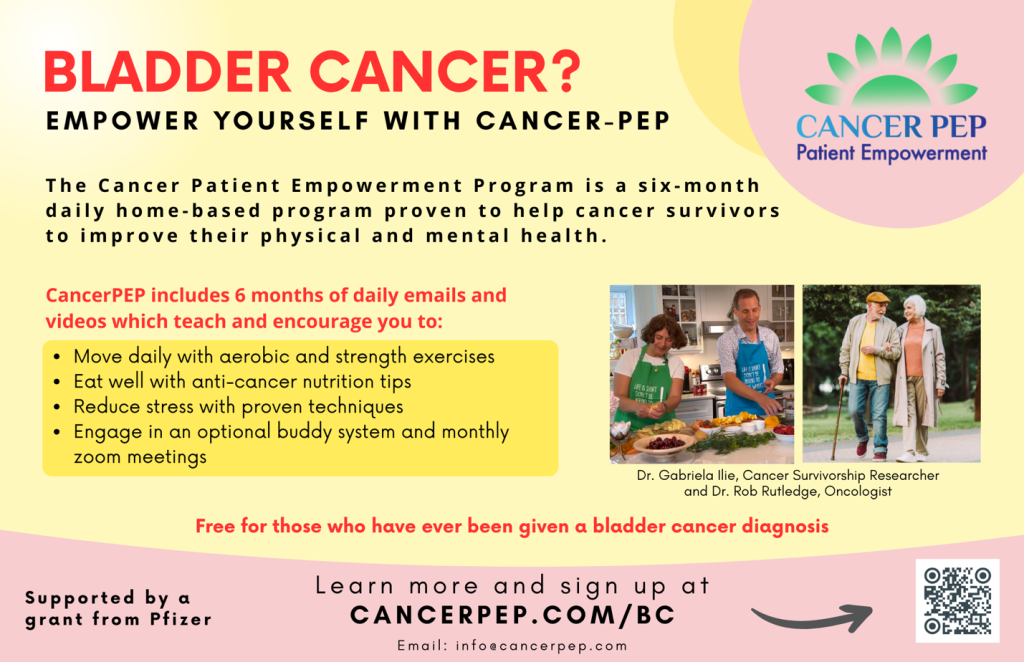
Cancer Patient Empowerment, based in Canada, have secured funding from Pfizer to provide a limited number of Australian patients a FREE 6 month health plan for bladder cancer.
SO…. CALLING OUT TO DOCTORS & PATIENTS – please offer this free program to your patients.
Sign up for Bladder Cancer PEP: A Free 6-Month Home-based Patient Empowerment Program
Are you or a loved one navigating life with a bladder cancer diagnosis?
Bladder Cancer PEP is a free, home-based, comprehensive 6-month health promotion program designed and scientifically proven to improve the mental and physical health of diverse cancer survivors.
Developed by an Oncologist and a Psychology Professor, Cancer PEP offers 182 daily emails and videos (exercise, dietary advice, stress reduction…) with practical strategies to help you thrive during and after treatment.
Free to anyone who has even been given a bladder cancer diagnosis of any stage.
Learn more and sign up at www.cancerpep.com/bc or email: Dr. Rutledge at Rob.Rutledge@nshealth.ca
Watch our inspiring documentary, “Empower”, featuring real stories of resilience and transformation: www.cancerpep.com/empower
UROGP Wrap

Professor Nathan Lawrentschuk lauds the success of the 2025 Urology in General Practice Symposium
“The feedback I received from many GPs spoke to the value they found in learning more about urological conditions experienced by their patients. Hearing experienced and expert urologists detail the variations and nuances of urological conditions helped the GPs, as primary care practitioners, gain an enhanced understanding of best practice and innovation in diagnosis, care and treatment strategies” stated Professor Lawrentschuk.
“We are delighted with the number of GPs who participated this year and aim for even greater engagement next year. In particular, we hope to see more participants from interstate. For the past 16 years that UroGP has been running, most of the medicos have come from Victoria, however we hope that 2026 will attract more colleagues from other states.”
The annual symposium attracted over 450 participants, comprised of General Practitioners, Nurses and Oncologists. More than 20 Urologists presented on topics including: PSA testing; prostate MRIs; urological dermatology; testicular cancer; haematuria; kidney lesions; new therapies in BPH; bladder cancer; radiation therapy; robot assisted surgeries; options for incontinence; pelvic pain; urinary tract infections; vasectomy and reversal; and erectile dysfunction. The program also included a question-and-answer session on research with the Young Urology Researchers Association (YURO).
Our own organization, Bladder Cancer Australia, participated with an information booth, handing out many of our Bladder Cancer Patient Guidebooks and our Patient Procedure Guides. Our fund-raising raffle saw Mike Barnachea as the very happy winner of the guitar prize. A successful day for all involved!

MORE ABOUT THE YOUNG UROLOGY RESEARCHERS ORGANIZATION
The Young Urology Researchers Organization (YURO), is an organisation of researchers, clinicians, and medical students devoted to promoting urology-related research among the medical and wider community.
As an Australian-based organization, what makes YURO stand out is the diversity of its membership; connections to on-the-ground research; and translation of research findings to clinical practice. Our work in the past has led to multiple peer-reviewed publications in the field of Urology, inclusive of bladder cancer. Consisting of a passionate team of students and doctors from all walks of life, YURO’s research output spans health system deliveries during the pandemic to clinical trials involving diagnosis of bladder cancer. While these examples highlight some of the projects in which our team members are involved, the significant factor is that we are all focused on one goal – that of improving health outcomes and public awareness related to urology.
Within YURO we enthusiastically welcome collaboration – and that involves the inspiration of research ideas amongst team members as well as collaborations with like-minded individuals such as medical professionals, academics, other researchers and community members; and organizations.
One such organisation covering all aspects of bladder cancer which we are honoured to be collaborating with is this organisation, Bladder Cancer Australia, which as the reader will know is focused on public awareness campaigns for bladder cancer. Its signature role is providing critical information on all aspects of bladder cancer to patients and medical professionals.
We would also like to reach out to patients and medical professionals and invite them to become involved with us. Join YURO if you’re interested in our research, we’d like to welcome you on board! You can find us on our Facebook page, or contact us on: yurourology@gmail.com
USANZ & ANZUNS 2026 in Melbourne

On Saturday 28th February through to Tuesday 3rd March, all medicos and companies involved in the urology field will gather in Melbourne for the annual urology conference hosted by the Urological Society of Australia and New Zealand (USANZ) and the Australian and New Zealand Urological Nurses Society (ANZUNS). If you are involved in urology, and especially with Bladder Cancer, it is a vital event.
You can register to attend here:
Things to do in Melbourne that weekend:
• FREE Antipodes Greek Festival
• Last shows for Book of Mormon
• Victoria Market Summer Night Market
• Visit the brilliant NGV galleries
• FREE Australian art at the Ian Potter Gallery. All our best artists on display.
• Hidden Melbourne Ghost Tour
• Hidden Secrets Walking Tour
Maybe try a Foodie Tour – many options.
So many GREAT restaurants to try: Taxi Kitchen, Movida, Philippe, Flower Drum, Gimlet, Lee Ho Fook, Maison Batard, Maha. Or walk to Lygon St in Carlton for Little Italy, or tram to St Kilda Beach for Di Stasio, or the Stokehouse.
Medical Update – Immunotherapy for Bladder Cancer
Immunotherapy is a treatment that stimulates the body’s immune system to kill cancer cells. It is also called biologic therapy, and is designed to boost the body’s natural defences to fight the cancer. It uses materials made either by the body or in a laboratory to improve, target, or restore immune system function. BCG (Bacillus Calmette-Guerin) is one form that is given directly into the bladder (intravesically). However, in more advanced cases where metastatic disease is present clinicians are now exploring the use of Systemic Immunotherapy, which employs a range of drugs.
Immunotherapy, is an exciting treatment for bladder cancer. It is also called biologic therapy, and is designed to boost the body’s natural defences to fight the cancer. It uses materials made either by the body or in a laboratory to improve, target, or restore immune system function.
Immunotherapy has been an area of significant research in recent years. A plethora of clinical trials have been undertaken investigating their use in the treatment of metastatic bladder cancer. Immune checkpoint inhibitors have emerged as new targeted agents (e.g. pembrolizumab, avelumab, nivolumab) that are used in certain settings. They could also be considered in patients with a poor functional baseline instead of chemotherapy, but is still an unclear area requiring further research.
Examples of Systemic Immunotherapy Drugs
1. Pembrolizumab (pharmaceutical name Keytruda) does not have a survival benefit over standard chemotherapy. As such, it is approved by the Australian TGA (Therapeutic Goods Administration) as the next-line option in patients who are not eligible for any platinum-based chemotherapy. However, it is not PBS (Pharmaceutical Benefits Scheme) subsidised in Australia for this purpose. Furthermore, pembrolizumab is also used as second-line treatment in patients who have had metastatic bladder cancer after having had platinum-based chemotherapy. It is both TGA and PBS-approved for this indication.
2. Atezolizumab (pharmaceutical name Tecentriq) is similarly TGA-approved in patients unable to have cisplatin and whose tumors express a protein called programmed death-ligand 1 (PD-L1). However, like pembrolizumab, it is also not PBS-subsidised, which limits uptake of these agents in Australia.
3. Avelumab (pharmaceutical name Bavencio), another checkpoint inhibitor, is the recommended maintenance therapy for patients who have responded to the first-line platinum-based chemotherapy in Australia.
4. Nivolumab (pharmaceutical name Opdivo), a PD-1 inhibitor, is another second-line therapy option after chemotherapy in patients with metastatic bladder cancer. It is TGA-approved, but not PBS-subsidised.
Currently, a new antibody-drug conjugate called Enfortumab Vedotin (EV) is used as third-line treatment on patients who have progressed both on chemotherapy and immunotherapy. A large clinical trial (EV302) comparing EV combined with immunotherapy against chemotherapy is underway with the results eagerly awaited. Targeted molecular therapy of patient genomics is another area of exciting growth in coming years. There are also other clinical trials ongoing currently involving either single or multi-agents in a constantly shifting landscape.
If you need more Bladder Cancer Patient Guidebooks for your hospital or surgery, contact us at contact@bladdercancer.org.au